Waldorf, Maryland
Garage Door Opener Repair in Waldorf, MD
Garage Door Opener Repair in Waldorf, Maryland, with the published national price range up front, the full system inspected on site, and the price stated before any work begins.
Waldorf, Maryland
Garage Door Opener Repair in Waldorf, Maryland, with the published national price range up front, the full system inspected on site, and the price stated before any work begins.
When a garage door opener quits in Waldorf, it usually does not quit all at once. It hesitates. It reverses halfway down for no reason it will explain. It hums, clicks, or grinds, opens by remote but not by keypad, or works fine for a week and then refuses on the morning you are already late. Those small misbehaviors are the opener describing its problem, and most of them trace back to a short list of parts that wear, drift, or burn out years before the door itself does.
Opener repair starts with diagnosis rather than parts swapping. A door that stops mid-travel might have a sensor problem, a force setting problem, a worn gear, or a perfectly healthy opener being asked to lift a door whose springs have failed. Replacing parts without separating those causes is how homeowners end up paying twice for the same symptom.
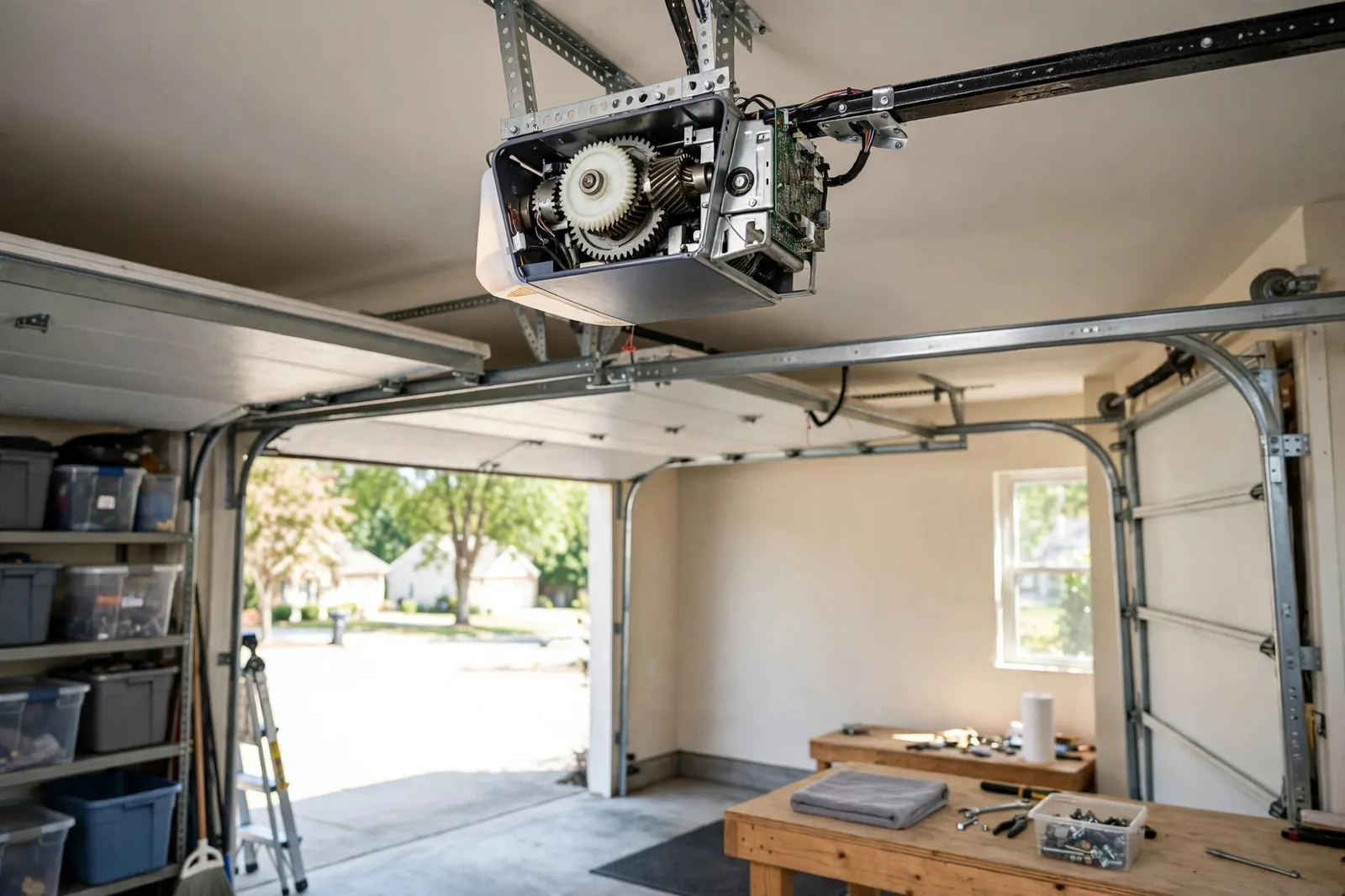
Stripped gears lead the list on older units. Inside many openers, a nylon gear set transfers the motor's work to the drive, and after years of cycles the gear teeth wear smooth until the motor runs and nothing moves. The tell is a humming or whirring unit, sometimes with white plastic shavings in the housing, and a door that does not budge.
Logic boards come next. The board is the opener's brain, and it takes the hits from power surges during Southern Maryland thunderstorms. A board failure looks like erratic behavior: lost remote programming, a door that opens on its own schedule, or a unit that responds to nothing at all. Safety sensors cause their own family of symptoms. When the photo eyes at the base of the tracks are bumped out of alignment, blocked, or sun-blinded, the door refuses to close and the opener light blinks its complaint.
Remotes and keypads fail more simply: batteries, worn buttons, lost programming after an outage. Travel and force settings drift over time as doors and springs change, leaving a door that does not fully close or reverses against the floor. And sometimes the opener is honestly reporting a door problem: a broken spring makes the door far heavier than the opener's force limit allows, and the opener shuts down to protect itself. That shutdown is information, not failure.
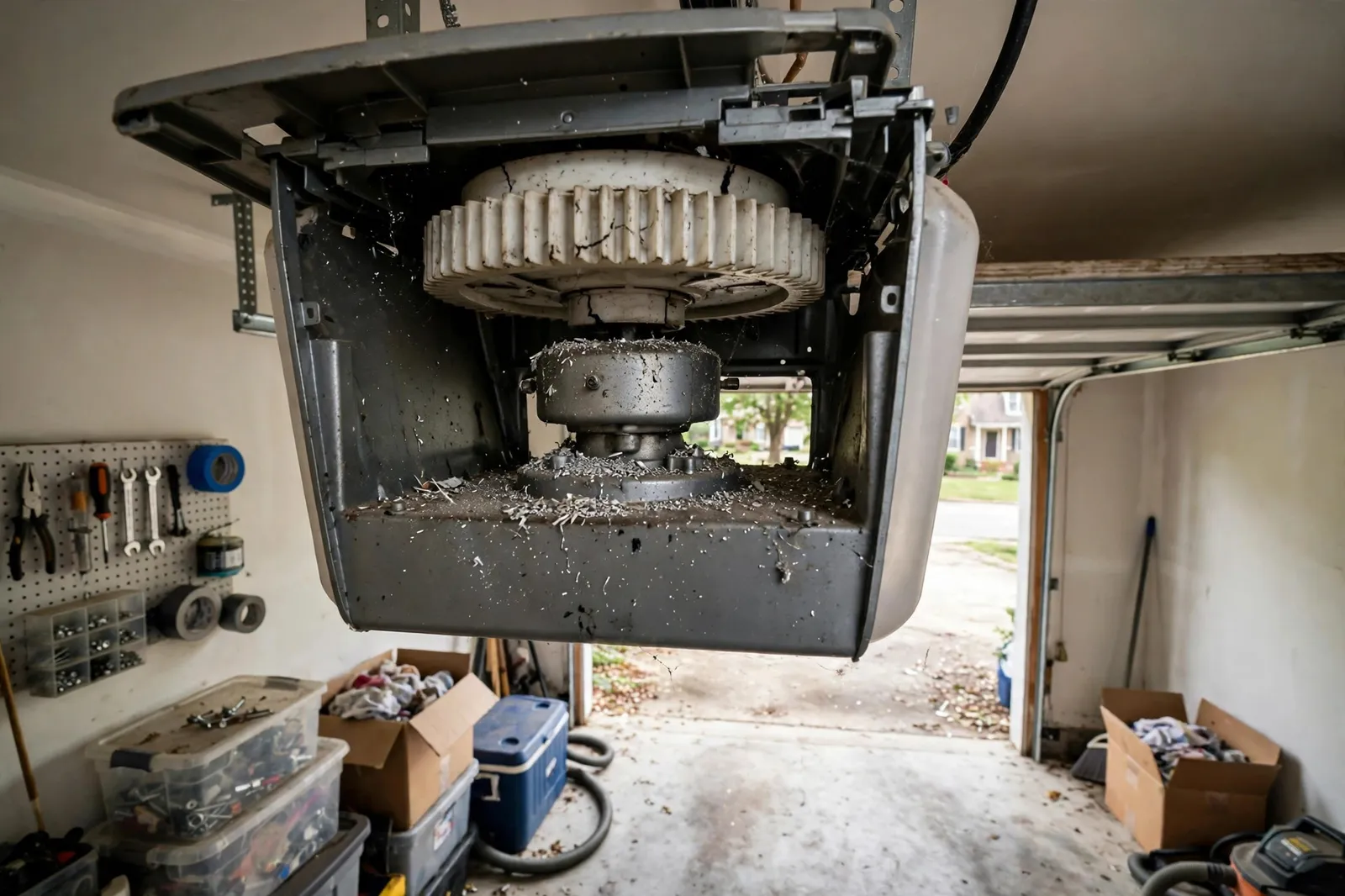
A Sheffield homeowner's opener had started humming without moving the door, and white shavings inside the housing pointed to a stripped drive gear. The door itself tested balanced and its springs were sound, so the unit was worth saving. We replaced the worn gear and sprocket assembly, lubricated the drive, reset the travel and force limits, confirmed the safety sensors, and reprogrammed a remote that had lost its settings during the failures.
No Waldorf company publishes a local price list for this work, so the figures here are published national ranges, labeled as national, and they frame the decision every opener repair comes down to: repair this unit, or put the money toward a new one.
A service call to diagnose a door or opener problem runs $75 to $150 nationally, according to published figures from Housecall Pro's 2026 table. On the other side of the ledger, full opener replacement, old unit out and new unit in, runs $300 to $800 nationally in the same table, and Angi 2026 puts a new opener installation at $218 to $540 with an average around $379.
Where a repair lands between those poles depends on the failed part. A sensor realignment or a remote problem is a small job. A gear assembly or a logic board is a larger one, and on a unit that is already old, the honest conversation compares the repair figure against the replacement range before any part is ordered. We will walk through that comparison with the numbers on the table.
The first step is reproducing the symptom with the door attached and then with the opener disconnected, which separates opener faults from door faults in minutes. A balanced door that lifts easily by hand clears the springs and tracks; a door that is heavy or crooked sends the visit in a different direction entirely, and we will tell you that plainly rather than selling you opener parts for a spring problem.
With the fault isolated, the failed component is replaced or adjusted, and then the whole system gets verified: travel limits, force reversal against an obstruction, photo-eye function on both sides, remote and keypad operation, and the release cord. A repair that ends with the door merely moving is not finished. It ends with the door moving correctly through full cycles, with its safety systems confirmed.
Published national figures put a diagnostic service call at $75 to $150. The repair itself depends on the failed component: a sensor or programming issue sits at the low end, while a gear assembly or logic board costs more, and any repair quote deserves comparison against the national replacement range of $300 to $800 before you decide. Send the quote form describing the symptom and we will respond with the range that applies to your situation.
The honest test has three parts: the age of the unit, the cost of the failed part against the replacement range, and whether the unit has safety features worth keeping. A mid-life unit with one worn gear is usually a repair. An older unit needing a logic board, missing modern photo-eye protection, or failing repeatedly is usually a replacement conversation. We lay out both figures and let you choose with the whole picture in view.
The most common cause is the photo-eye sensors: one is bumped, blocked by a leaf or a bin, or blinded by direct sun, and the opener reads it as an obstruction. The second cause is force settings that have drifted, so the opener mistakes normal resistance for something in the way. The third is a door problem, such as a binding roller or a failing spring, making the door genuinely harder to move. Each cause has a different fix, which is why diagnosis comes first.
A humming unit with a stationary door usually means the motor is turning but the drive connection has failed, most often a stripped gear set in older openers. It can also mean the trolley has disengaged from the rail. Either way, stop cycling the unit; repeated attempts overheat the motor and can turn a gear replacement into a full unit replacement. Note the symptom in the quote form and we will take it from there.
Outages and surges commonly clear an opener's programmed codes or, on older boards, damage the receiver. Start with fresh batteries in the remote and a reprogram attempt using the learn button on the unit. If the opener will not hold programming, or other functions behave strangely, the logic board may have taken surge damage during the storm. That pattern, especially combined with other odd behavior, points to a board-level repair.
It has to. An opener is only as healthy as the door it guides, and many opener failures are caused or worsened by the door: failing springs overload the motor, worn rollers add resistance on every cycle, and a crooked door confuses the force settings. Every repair visit here includes a balance check and a look at springs, cables, and rollers, because handing back a repaired opener on a failing door just schedules the next breakdown.
Tell us what the door is doing, or not doing. We read every request that comes in and respond with the published national range for that kind of work and the next step, starting with a visit to inspect the full system on site.
Prefer to talk it through first? Send the form and we will call you back at the number you give us.